
How a full arch on implants works
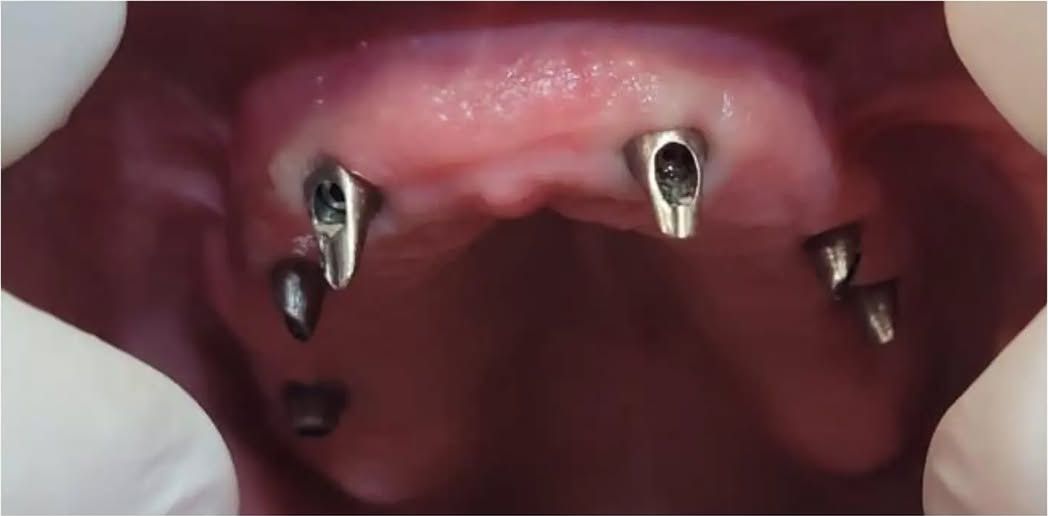
When most teeth in a jaw are missing or failing, replacing each one with its own implant is rarely necessary or sensible. Instead, a small number of implants is placed at carefully chosen points along the jaw, and a single fixed bridge of teeth is attached to them. In All-on-6, six implants carry the arch.
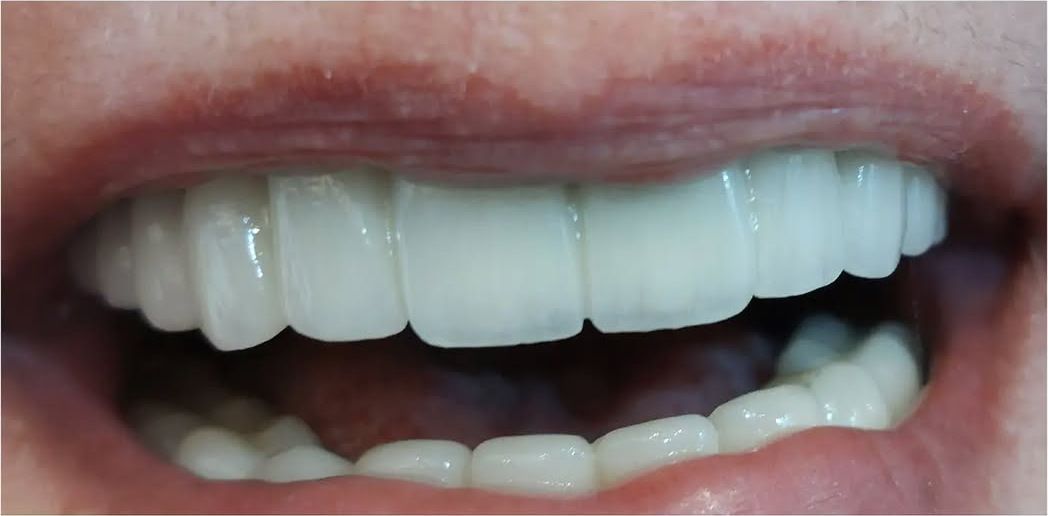
The implants are positioned to make the best use of the available bone and to spread the forces of chewing evenly. The arch they support replaces the teeth and, where needed, some of the gum, so that the lips are supported and the smile looks natural. It is attached with small screws, which means it stays fixed for you but can be removed by the dentist for maintenance.
All-on-4 and All-on-6
Both are full-arch concepts. All-on-4 supports a fixed arch of teeth on four implants; All-on-6 uses six. The idea is the same: a complete set of fixed teeth carried by a few implants rather than one implant per tooth.
Which is appropriate depends on the amount and quality of bone, the shape of the jaw, the bite and the design of the restoration. Neither is better in every case, and the number of implants is a clinical decision made for the individual patient. The full-arch cases shown on this website are All-on-6 cases.
The treatment, step by step
- Consultation and records. Your concerns, medical history, current teeth and bite are reviewed. Photographs and impressions or scans may be taken.
- Imaging and planning. Three-dimensional imaging shows the bone along the whole jaw. The implant positions and the shape of the new arch are planned together.
- Extractions and implant placement. Any remaining teeth that cannot be kept are removed, and the implants are placed under local anaesthesia. When the implants are stable enough, a temporary fixed arch may be fitted soon after.
- Healing. The implants integrate with the bone over a period of months. A soft diet is advised at first, then gradually firmer foods.
- The final arch. Once healing is complete, the final arch is designed, tried in, adjusted for bite, speech and appearance, and fixed to the implants.
Healing and recovery
Full-arch surgery is a bigger procedure than a single implant, and it is normal to have swelling and tenderness for several days. Most people plan a few quiet days afterwards. Detailed written instructions cover diet, cleaning, pain relief and what to watch for. Follow-up visits check healing and adjust the temporary arch as the gums settle.
Living with a fixed arch
A full arch on implants is designed to let you bite, chew and smile with confidence, without adhesives or a removable plate. It does still need care.
- Clean around and under the arch every day with the tools shown at the fitting appointment.
- Attend regular reviews so the implants, gum, screws and bite can be checked and the arch professionally cleaned.
- Protect the arch from grinding with a night guard if this is recommended.
- Report any looseness, clicking, soreness or bleeding early.
Risks and limits
Risks include those of any implant surgery, such as swelling, infection and, rarely, nerve or sinus involvement or an implant that does not integrate. Over the years, parts of the arch can wear or chip and may need repair, and screws can loosen. Smoking and uncontrolled diabetes increase the risk of problems. These points are discussed openly before treatment.
How the cost of full-arch treatment is worked out
Full-arch treatment is planned as a whole, and the cost depends on the number of implants, whether extractions or bone management are needed, the temporary arch, the material and design of the final arch, and the number of visits. After examination and imaging, you receive a written plan that sets out each stage before you decide.
